
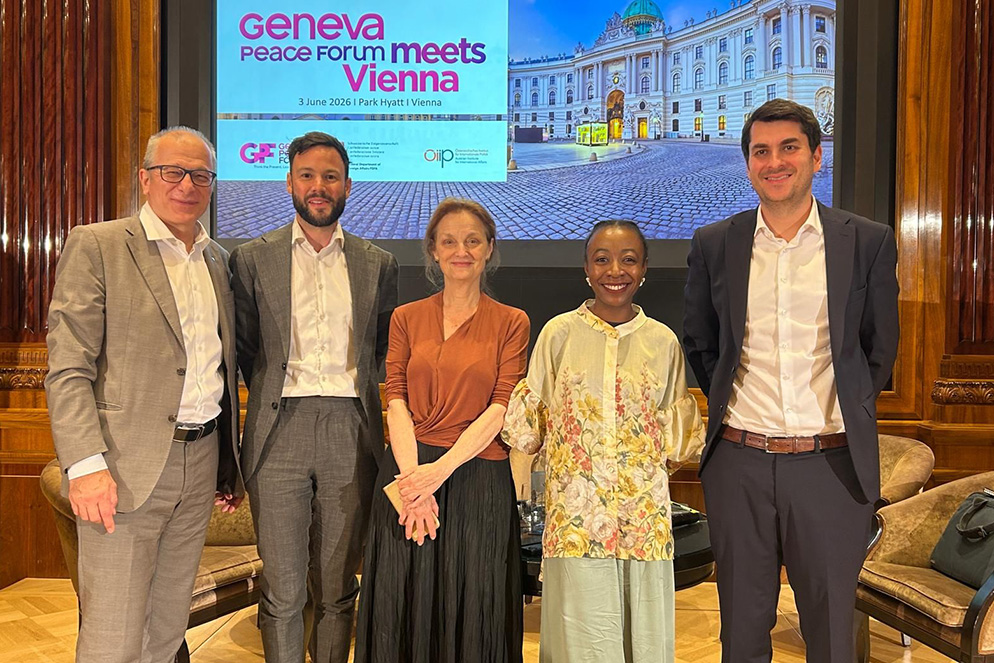
Pictured: Panel participants following the Geneva Peace Week meets Vienna.
BY Verena Serini / ON 30 JUNE, 2026
On 3 June, the PeaceTech Alliance co-organised a panel discussion at Geneva Peace Forum Meets Vienna, bringing together policymakers, researchers, peacebuilders and civil society representatives to explore the opportunities and challenges emerging technologies present for peacebuilding.
The event formed part of a wider programme examining the future of peace and security, connecting Geneva and Vienna's multilateral communities through discussions on conflict prevention, humanitarian action and international cooperation.
The PeaceTech session, Risks and Opportunities in PeaceTech: The Need for a People-Centered Approach, focused on how technologies such as artificial intelligence, data-driven analysis and digital platforms are increasingly shaping peacebuilding practice. While these technologies present significant opportunities to strengthen dialogue, improve conflict analysis and support practitioners, the discussion also explored the governance questions that accompany their growing influence.
A recurring theme throughout the conversation was that PeaceTech is not defined by the technologies themselves, but by how they are designed, governed and applied. Participants reflected on the importance of ensuring that innovation remains grounded in peacebuilding principles, with particular attention given to participation, accountability, inclusion and local ownership.
The discussion also considered the growing risks surrounding emerging technologies. As AI and digital systems become more prominent across peace and security, questions were raised about commercial influence, militarisation and the unintended consequences that can arise when technologies are deployed without sufficient understanding of local contexts. The panel highlighted that technologies introduced with positive intentions can still reinforce inequalities or create new forms of exclusion if they are not developed alongside the communities they are intended to serve.
Examples shared during the session reinforced that successful PeaceTech initiatives depend on far more than technical innovation. Trust, collaboration and meaningful engagement with local actors remain essential if digital tools are to support sustainable peacebuilding outcomes. Rather than positioning communities as end users, participants emphasised the importance of involving peacebuilders directly in the design, governance and implementation of emerging technologies.
Questions surrounding data sovereignty and digital autonomy also featured prominently throughout the discussion. As AI systems increasingly rely on data collected from diverse contexts, participants reflected on the importance of ensuring communities retain meaningful influence over how information is gathered, managed and used. The discussion reinforced that effective PeaceTech must reflect the realities, priorities and lived experiences of the people closest to conflict.
For the PeaceTech Alliance, the discussion reaffirmed a simple principle: PeaceTech should be built in the image of peacebuilding, not in the image of the technology sector. As the field continues to evolve, ensuring that innovation remains people-centred, ethically governed and shaped by those it seeks to support will be critical to its future.
The panel was moderated by Heather Wokusch, Executive Director of MESPERO: Impact for Resilience, and featured Helmut Leopold (AIT Austrian Institute of Technology and PeaceTech Alliance), Simon Ilse (Heinrich Böll Foundation), Ted Holmquist (Principles for Peace), and Esther Madi (E-Baraka).
Thank you to the Geneva Peace Forum, Heinrich Böll Foundation, Principles for Peace, all of the panellists and everyone who joined the discussion for helping advance an important conversation about the future of people-centred PeaceTech.