
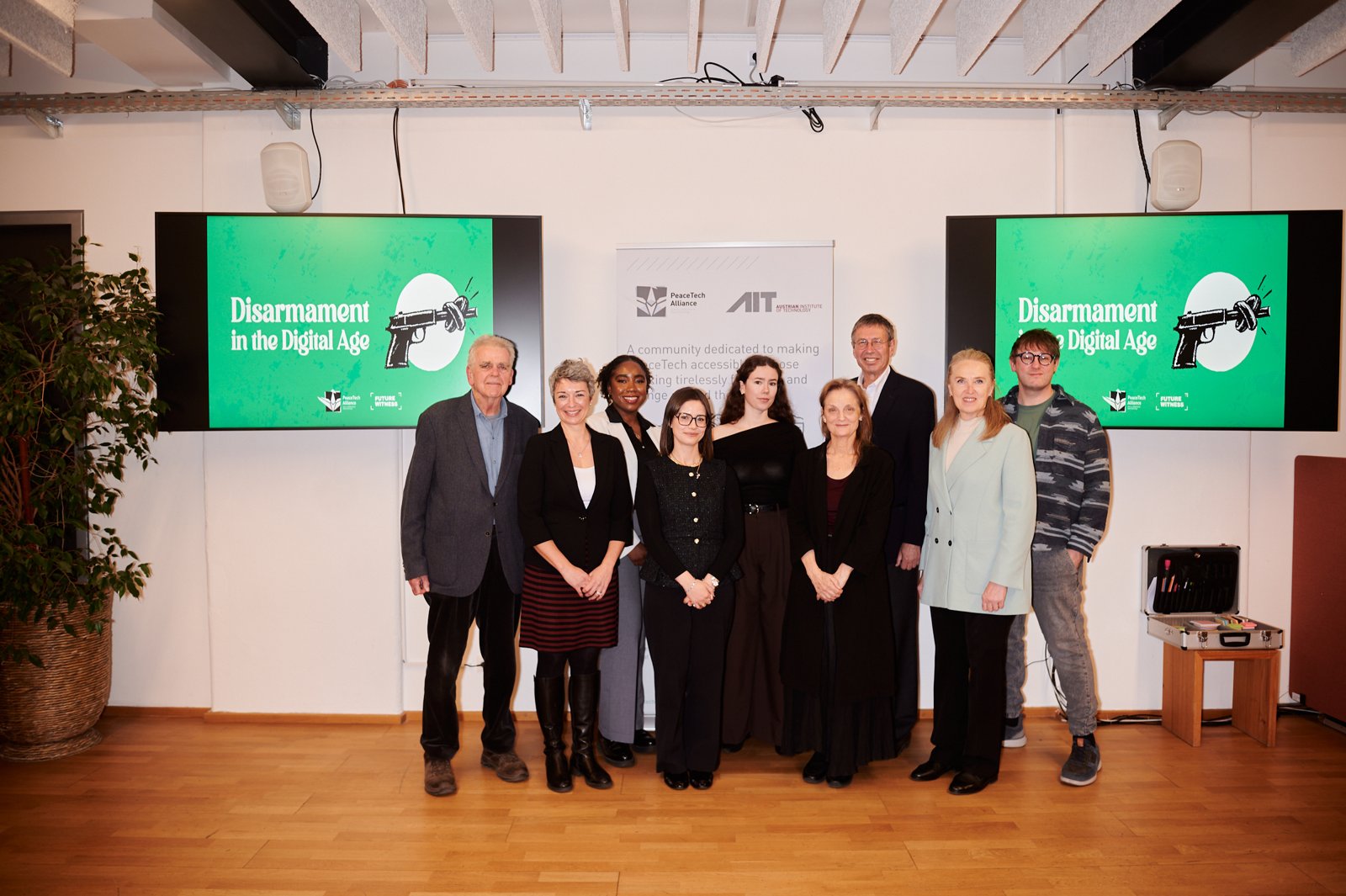
Speakers and organisers of “Disarmament in the Digital Age”, the inaugural Future Witness Series event, held in Vienna during UN Disarmament Week. © Valerie Maltseva
BY The PeaceTech Alliance / ON 14 NOVEMBER, 2026
Artificial intelligence (AI), autonomous systems and the digitalisation of conflict are transforming the global security landscape. They are changing how weapons are developed and deployed, how risks emerge and how international cooperation must respond. Against this backdrop, the PeaceTech Alliance convened Disarmament in the Digital Age in Vienna.
The event also marked the inaugural gathering of the Alliance's Future Witness Series and the launch of Future Witness, a digital platform designed to promote awareness of the defining issues shaping our collective future.
Nathan Coyle, Strategic Lead for PeaceTech at the AIT Austrian Institute of Technology and Co-Founder of the PeaceTech Alliance and Moumi Awudu, Co-Founder of the African Law Students’ Organization, opened the event by tracing the series of initiatives that had led to this gathering: the July 2026 visit to Austria of atomic bomb survivor Setsuko Thurlow, the PeaceTech Alliance’s subsequent design-thinking workshop to explore ways of reshaping the narrative around nuclear weapons, and finally this intergenerational dialogue.
Coyle highlighted the importance of bringing technology, diplomacy and peacebuilding together to address emerging global security challenges, while Awudu emphasised the legal and ethical questions raised by new technologies. Their opening remarks set the scene for an evening exploring how innovation, international law and collaboration across generations can contribute to a more peaceful and secure future.
The first panel, moderated by Heather Wokusch, explored the intersection of AI, weapons of mass destruction (WMD) and disarmament, bringing together perspectives from international law, research and nuclear policy.
Thomas Hajnoczi, former Ambassador and Permanent Representative to the United Nations in Geneva, discussed existing international legal frameworks and whether they are sufficiently equipped to address the challenges posed by AI. Drawing on the principles of international humanitarian law – distinction, proportionality and precaution – he noted the regulation of autonomous systems and the importance of ensuring that emerging technologies remain consistent with international law.
Elena K. Sokova, Executive Director of the Vienna Center for Disarmament and Non-Proliferation (VCDNP), explained how AI is creating both opportunities and vulnerabilities in the field of disarmament. She presented examples of VCDNP initiatives advancing research and education on AI's implications for human security, while stressing the importance of international cooperation in addressing emerging risks.
Federica Petrucci, Engagement and Network Assistant at Open Nuclear Network (ONN), focused on additional opportunities and risks AI presents for nuclear disarmament and non-proliferation. She emphasised the importance of engaging and involving young people and civil society at large in shaping the future of disarmament.
The discussion underscored the necessity for international cooperation, inclusive dialogue and continued efforts to ensure that AI is developed and used in ways that support disarmament and international security.
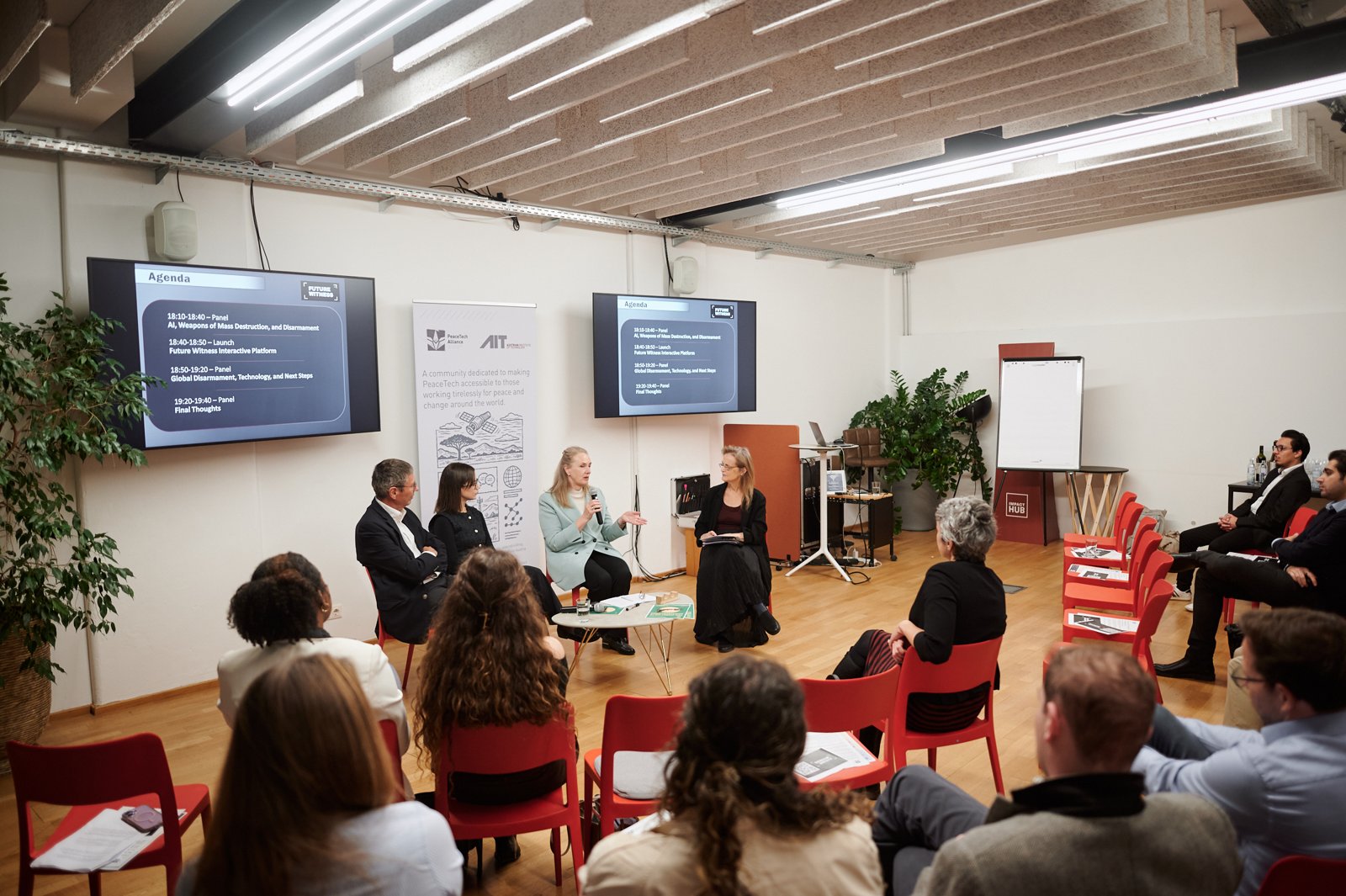
The first panel on AI, weapons of mass destruction and disarmament, moderated by Heather Wokusch. © Valerie Maltseva
The second panel, moderated by Nathan Coyle, shifted the focus to the broader disarmament landscape, exploring the current state of global disarmament along with practical steps to strengthen international cooperation and civil society awareness.
Rebecca Jovin, Chief of the UN Office for Disarmament Affairs (UNODA) Vienna office, emphasised that young people are already interested in disarmament but need more opportunities to learn and contribute. She cited the 8,400 applications received for 100 places in the second cohort of the ‘Youth Leader Fund for a World without Nuclear Weapons’ program; she also outlined the diverse resources available on UNODA’s Disarmament Education digital platform.
Peter Rickwood, Head of Atomic Reporters, discussed the challenges of communicating complex nuclear issues through the media. He stressed the need for accessible, dedicated journalism to bridge the gap between specialist knowledge and public understanding, noting that AI poses additional challenges for quality reporting on nuclear weapons and other existential risks.
Caitlin Roche, pursuing an advanced degree at the Diplomatic Academy of Vienna, highlighted the need for innovative approaches to disarmament education for younger generations. She emphasised the value of targeted digital-learning tools as well as opportunities for young people to exchange perspectives, participate in discussions and actively contribute to disarmament initiatives.
Together, the panellists explored the links between diplomacy, media and education, underscoring that disarmament requires more than international agreements. It also depends on public understanding, informed participation and trust. Moderator Nathan Coyle mentioned the potential of PeaceTech solutions to help bridge these gaps and support engagement.
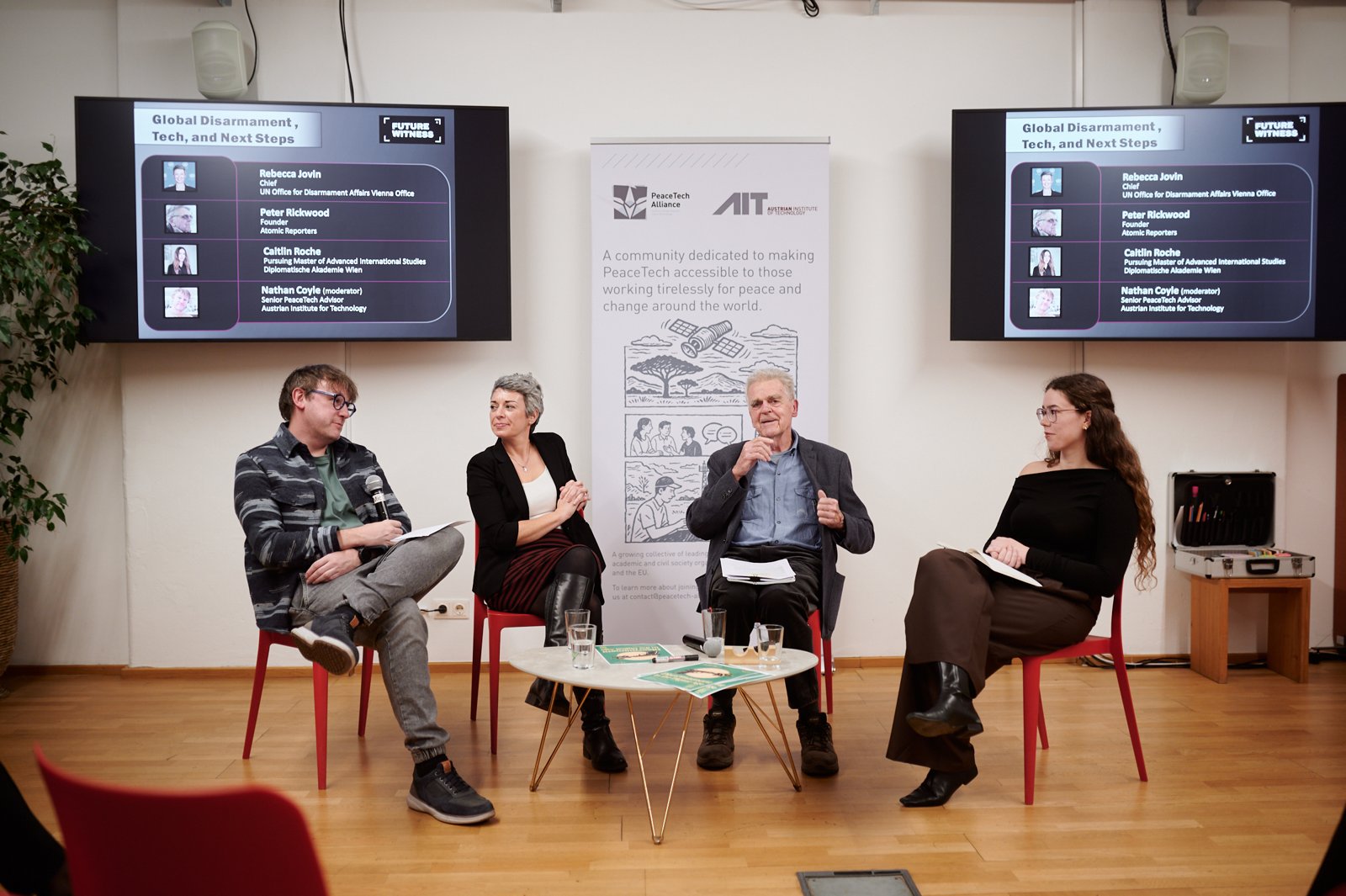
The second panel, “Global Disarmament, Tech, and Next Steps”, moderated by Nathan Coyle with Rebecca Jovin, Peter Rickwood and Caitlin Roche. © Valerie Maltseva
The event also saw the launch of Future Witness and the introduction of the Future Witness Series.
Future Witness is a shared, digital infrastructure designed to bring together different thematic areas, partnerships and audiences. Its first thematic hub, ‘Nuclear Weapons: Living with Existential Risk’, features interactive learning experiences, including a negotiation simulation, alongside digital storytelling that highlights lived experiences and personal perspectives.
Further thematic hubs are planned, exploring issues at the intersection of technology, security, human rights and societal transformation.
Described by its founder, Heather Wokusch, as "collaborative and intergenerational PeaceTech", Future Witness aims to make complex topics more accessible while creating opportunities for scalable education, ethical research, and informed public engagement.
Future Witness is part of the PeaceTech Alliance portfolio of projects, with its initial development phases supported by AIT. Helmut Leopold, Head of AIT Center for Digital Safety & Security: “Digital technologies can make a valuable contribution to peace and security, but only if we design and use them responsibly. This requires cooperation between researchers, peacebuilders, educators and civil society. Future Witness shows how digital tools can make complex issues such as nuclear disarmament accessible to a wider audience, strengthen informed dialogue and enable younger generations to actively contribute to decisions about their future.”
The corresponding Future Witness Series represents an upcoming programme of events and initiatives, reflecting the PeaceTech Alliance's belief that the future of peace and security must be shaped through intergenerational dialogue and collaborative approaches.
The evening concluded with a youth-led discussion with Moumi Awudu, Federica Petrucci and Caitlin Roche. They highlighted the need for accessible, scalable educational tools to encourage younger generations to engage with disarmament and other global challenges. The panel additionally emphasised that young people must be more than observers: their perspectives should actively inform the conversations and decisions shaping their future.
Returning to the central question of how technological innovation can strengthen rather than undermine human security, the panel discussed the growing influence of AI across daily life and the urgent need for appropriate safeguards and responsible governance.
In summary, this inaugural Future Witness Series event demonstrated the value of bringing together different generations and disciplines. It reinforced that disarmament is not only about weapons, technologies and international agreements; it is also about people, their knowledge, their choices and their willingness to work together across generations to build a more peaceful and secure world.
Through the Future Witness digital platform and related Series, the PeaceTech Alliance continues building bridges between diplomacy, technology, peacebuilding and education.